
Business Procedures: The Silent Manager That Scales Your SME
"Your best accountant goes on vacation for two weeks. On her first day away, an urgent client requests a copy of their latest invoice. You spend 45 minutes searching through her files. You can't find it. You end up calling your employee during her holiday."
"You hire a new administrative assistant. The previous one was "super efficient" but documented nothing before leaving. Planned training: 3 days. Reality: 6 weeks of trial and error, with constant questions that consume 10 hours of your time every week."
These situations aren't bad luck. They're symptoms of a structural problem: the absence of documented procedures. In Anglo-Saxon business terminology, we call these Standard Operating Procedures (SOPs).
In a growing Swiss SME, not everything can remain "in people's heads", whether employees or the entrepreneur. At some point, you must transition from oral to written, from informal to structured, from "we know how it works" to "it's documented and accessible."
Procedures aren't bureaucracy. Well-designed, they become one of your best growth tool: they train, supervise, decide, and optimize silently, 24/7, without ever asking for a raise.
What is a Business Procedure?
"Your Company's External Memory"
A business procedure (or Standard Operating Procedure - SOP) is the written, structured description of the best way to accomplish a recurring task in your organization.
Not a 50-page tome. Not an unreadable ISO manual. Just a clear, step-by-step explanation of "how we do this here." and it contains:
- Principles & responsabilities
- Precise steps to follow
- Necessary tools and documents
- Quality controls to perform
Objective: ensure each process (divided in sub-tasks) is executed identically, regardless of who performs it.
Concrete Example: Your Monthly Bank Reconciliation Procedure
Instead of: "Ask Sophie, she knows how to do it" / "It's complicated, look through her files" / "Wait until she gets back from vacation"
You should have (illustrative example) :
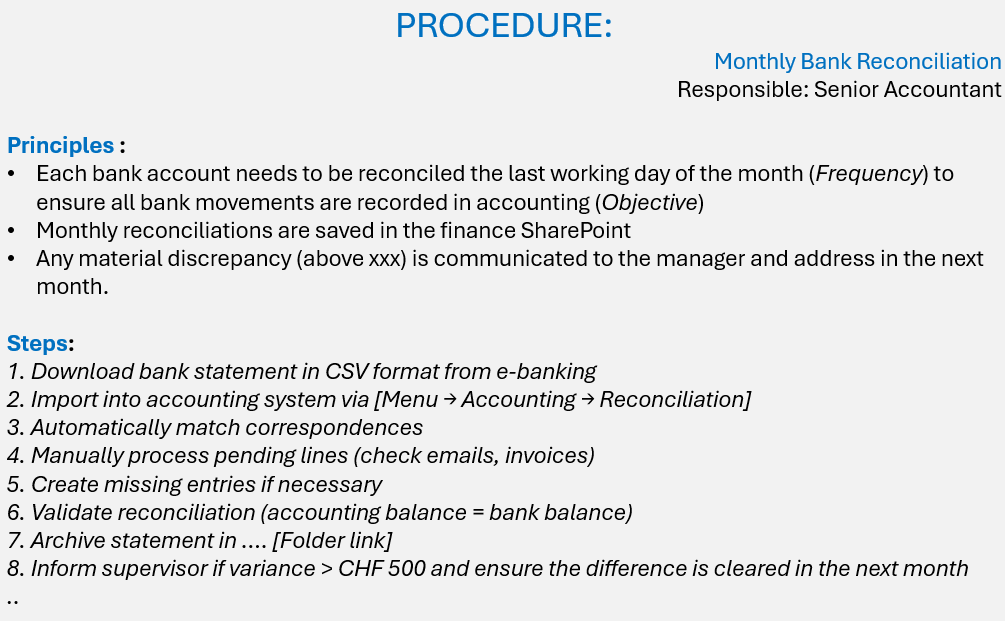
Result: any competent accountant can do it. Sophie can go on vacation. You can recruit a replacement who'll be operational in 2 days, not 2 months.
The 3 Key Benefits of Procedures
1. Scalability : You can grow without everything collapsing. Recruiting becomes easier, onboarding faster, growth more serene.
2. Quality : Everyone follows the same standards. Fewer errors, less variation, predictable results.
3. Autonomy : Your employees no longer interrupt you every 30 minutes asking "how do we do this." They consult the procedure.
Why Document Your Procedures: 5 Key Benefits
"A well-designed procedure functions exactly like a manager, except it never sleeps, takes no vacation, and never asks for a raise."
1. It Trains New Hires (Accelerated Onboarding)
Without procedures:
- Oral training by a busy colleague
- Incomplete information, frequent omissions
- "I think we do it this way, but I'm not sure"
- Onboarding: 6-8 weeks
With procedures:
- Structured, complete document, accessible 24/7
- New hire can progress autonomously
- Questions focus on special cases, not basics
- Onboarding: 2-3 weeks
Real gain: 4-5 weeks × salary saved per hire
2. It Supervises (Quality Standard)
Without procedures:
- Everyone does things "their own way"
- Quality depends on mood, fatigue, memory
- Impossible to compare or improve
With procedures:
- Standard defined and followed by all
- Deviations immediately visible
- Foundation for continuous improvement
3. It Decides (No More Need to Ask)
Without procedures:
- "How do I do this?"
- "Should I ask the boss?"
- 10 interruptions per day for trivial decisions
With procedures:
- The procedure decides: "If amount < CHF 1,000 → manager approval. If > CHF 1,000 → CFO approval"
- Team autonomy
- You focus on strategy

4. It Optimizes & Protect ( Improvement & compliance)
Without procedures:
- You optimize a process
- 3 months later, everyone's forgotten and returned to the old method
- Impossible to prove you follow best practice (complicated, costly audit, non-compliance risk)
With procedures:
- Improvement = procedure update
- Optimization anchored durably
- Version history = organizational learning
- Documentation for auditors, reviewers, tax authorities
- Proof of internal control (see our article Internal Control: 5 Essential Principles for Swiss SMEs)
- Reduced legal and operational risks
How Procedures Increase Your Company's Value
From Organized Chaos to Operational Excellence
A company's maturity isn't measured solely by revenue. It's reflected in its ability to function predictably, reproducibly, and scalably. Documented procedures are one of the most visible markers of this maturity.
The 4 levels of procedural maturity:
Level 1 - Heroic (typically 0-10 employees)
- Everything depends on a few key people
- Informal processes, oral transmission
- "We know how it works"
- Maximum vulnerability to departures
Level 2 - Repeatable (10-30 employees)
- Some key procedures documented
- Processes followed but not all formalized
- Still strong dependence on individuals
- Beginning of structure
Level 3 - Defined (30-100 employees)
- Procedures documented for critical processes
- Quality standards established
- Structured training for new hires
- Company can grow without breaking everything
Level 4 - Optimized (100+ employees or very mature SME)
- Complete procedure library
- Documented continuous improvement
- Culture of operational excellence
- Almost infinite scalability
The good news: you don't need to be at level 4 to reap benefits. Moving from level 1 to level 2-3 radically changes the entrepreneur's life.
Who Your Procedures Reassure (and Why It's Strategic)
1. You, the entrepreneur
"I can go on vacation for two weeks without everything collapsing."
Documented procedures free you from the prison of daily operations. You transition from permanent firefighter to strategic architect. You sleep better at night.
2. Your managers and employees
"I know exactly what's expected of me and how to do my job well."
Employees hate ambiguity. "How do I do this?", "What's the right way?", "Why am I being criticized when nobody told me how to do it?"
Clear procedures create:
- Psychological safety: I won't be blamed if I follow the procedure
- Autonomy: I don't need to interrupt my boss every 30 minutes
- Equity: everyone plays by the same rules
- Pride: I work in a professional company
Result: calmer teams, reduced turnover, increased productivity.
3. Your investors (current or future)
"This company doesn't depend solely on its founder. It has real systemic value."
When an investor evaluates a Swiss SME, they want to understand if the company can continue performing without the founder at the helm 24/7. Documented procedures demonstrate:
- Scalability: the company can grow without reinventing everything
- Resilience: departure of a key person doesn't kill the business
- Facilitated due diligence: the investor sees how it really works
- Risk reduction: less key-person dependency
In venture capital or private equity, organizational maturity is a valuation criterion. At equal revenue, a proceduralized company will be worth 20-30% more than one where everything is in the boss's head.
4. Your potential successors
"I understand how the company works and know I can run it."
Preparing your succession or a sale in 5-10 years? Start your procedures today.
A buyer purchases : Your clients, Your teams and Your know-how...
If your know-how exists only in your head or that of 2-3 employees, you're not selling a company, you're selling a difficult job to someone who'll pay you less to compensate for the risk.
5. Your partners and clients (B2B)
"They're professional, I can trust them long-term."
In tenders, client audits, or simply daily perception, documented processes signal seriousness and reliability.
Certifications (ISO 9001, etc.)? Impossible without procedures. Large corporate clients? They'll request your quality, security, and compliance procedures.
The 5 Essential Types of Procedures in SMEs
Not all procedures are equal. Start by documenting those with the most impact.
A. Accounting and Financial Procedures
Why it's critical: Costly errors, fraud risks, legal obligations
Examples:
- Monthly closing (complete checklist)
- Purchase cycle: order → receipt → validation → payment
- Sales cycle: quote → order → invoice → collection
- Bank reconciliations
- Expense report management
- Provisions and adjustments
- Tax declarations (VAT, corporate tax)
Quick win: Document your monthly closing procedure this week. You'll finally be able to go on vacation worry-free.
Go further: Discover how to digitalize your accounting with Odoo to automate these processes.
B. HR Procedures
Why it's critical: Legal compliance, employee experience, equity
Examples:
- Onboarding: Day 1, Week 1, Month 1, Month 3
- Offboarding: departure checklist (equipment return, knowledge transfer, access)
- Leave and absence management
- Annual evaluation process
- Overtime management
- Disciplinary process
Quick win: Create your onboarding checklist. Every new employee should know exactly what happens on their first day, first week, first month.
Go further: Our Swiss payroll management services include help structuring your HR processes.
C. Operational Procedures
Why it's critical: Product/service quality, customer satisfaction
Examples:
- Production/delivery
- Inventory management (stock takes, receiving, shipping)
- Customer service (complaint handling, after-sales)
- Quality control
- Supplier management
Industry adaptation: A consulting firm will document its project delivery processes, an e-commerce shop its logistics processes.
D. IT and Security Procedures
Why it's critical: Data protection, business continuity, GDPR compliance
Examples:
- Access and password management
- Backups and restoration
- Security incident management
- User account creation/deletion
- BYOD policy (Bring Your Own Device)
Quick win: Document your backup procedure. Who does what, when, where backups are stored, how to restore.
E. Governance Procedures
Why it's critical: Internal control, traceability, compliance
Examples:
- Approval matrix (who validates what, from what amount)
- Signature process (contracts, commitments)
- Monthly/quarterly management reporting
- Crisis communication
- Conflict of interest management
Essential: These procedures are the foundation of your internal control system ,to prevent your business from error, fraud or exceptional circumstances.
How to Document: The DHAC Pragmatic Method
Not every task deserves a procedure. Focus on those with the most impact.
Prioritization matrix: Frequency (dailly, weekly, monthy) x Risk (consequences) x Complexity (number of steps, stakeholders, special case) x Turnover (is the task performed by a single person who could leave?)
Too simple = useless
- "Do the bank reconciliation" → No added value
Too complex = nobody reads it
- 15 pages with screenshots of every click → Impossible to maintain
The right balance: Start with principles and responsibilities, and for the operational part, ensure enough detail so a competent person in the field can execute autonomously.
The ultimate test: "Can a new employee with basic skills do this task alone following the procedure, without asking questions?"
A good procedure contains these essential elements:
1. Objective (Why we do this) and Principles
- "Ensure all bank movements are recorded in accounting"
- Principle: Each bank movement must be properly accounted for
2. Responsible (Who does it)
- "Senior Accountant"
3. Trigger / Frequency (When)
- "Last working day of the month"
4. Steps (How - max 10-12 steps) and Deliverable
- Numbered list, clear, action by action
- Example deliverable: "Reconciliation is prepared and saved in the shared finance space"
5. Tools / Documents (With what)
- Software used, templates, document links
6. Controls (How we validate it's done correctly)
- "Accounting balance = bank balance"
- "CFO validation if variance > CHF 500"
Avoid: Paper binders (nobody consults), emails (impossible to find), boss's head (not scalable)
Prefer: - Internal wiki (Notion, Confluence, Google Sites) - ERP Documents module (Odoo) - Structured SharePoint/Google Drive Our recommendation: For 5-30 employees, well-organized SharePoint or Google Drive works perfectly. Beyond that, invest in a wiki or use your ERP's document module.
The best-written procedure is useless if nobody knows it exists.
Mandatory actions:
- Initial training: Present the procedure to all concerned parties
- Accessibility: Everyone knows where to find THE procedures (single reference location)
- Culture: Install the reflex "Check the procedure first before asking"
- Reminders: Mention procedures in meetings, onboarding, evaluations
Tip: During team meetings, take 5 minutes to review/revise a key procedure. Rotate each week. In 20 weeks, you've covered your 20 main procedures.
Ready to Hire your first Silent Manager?
At DHAC, we support Swiss SMEs in building robust, practical procedure frameworks. We offer three levels of support:

Level 1: Review & Finalization

Level 2: Co-Creation

Level 3: Optimization & Transformation
Ready to get started ? Contact us for an initial discussion. We'll jointly assess your maturity level, identify your 5-10 critical procedures, and recommend the right approach.
You want to go even further ? what about the next level ?
Procedures and Digitalization: Moving to the Next Level
Automated Workflows = "Living" Procedures
Documentation is good. Automation when possible should be always prefered. Manual processes relying on documentation is requiring a certain discipline to archive the documentation for audit trail. Digitalization and automation allows today to document approvals on line (rather than email or signature exchange), to archive automatically the eventual required document in a central place and linked to a specific transaction, ideal for audit trail and understanding what happened).
Examples of Automatable Procedures in an ERP
Odoo (our expertise at DHAC) enables automation of:
- Multi-level approvals (purchases, expenses, leave)
- Automatic customer reminders based on invoice age
- Automatic generation of accounting entries
- Threshold alerts (low stock, payment delay, budget exceeded)
- Recruitment workflow (from application to onboarding)
The principle: The procedure becomes the workflow. The system enforces step compliance. You gain in conformity AND efficiency.
Go further: Discover how DHAC digitalizes your processes with Odoo.
Fatal Errors to Avoid
Error 1: Documenting Everything at Once
The trap: "We'll document our 200 processes in 3 months!"
Result: Exhaustion, frustration, abandonment after 2 weeks.
The right approach: Start small. 5 critical procedures. Then 5 more. Then 5 more. Iterative approach.
Error 2: Obsolete Procedures
The trap: You document in 2024. In 2026, everything's changed but the procedure is still the same.
Result: Nobody follows procedures because they no longer match reality.
The right approach:
- Mandatory annual review of all procedures
- Immediate update when a process changes significantly
- Designated owner for each procedure (responsible for updates)
Error 3: Procedures = Bureaucracy
The trap: Creating procedures so heavy they paralyze action.
Result: Team resistance, procedure circumvention, loss of agility.
The right approach:
- Well-done procedure = liberation, not constraint
- If a procedure slows without adding value, simplify or eliminate it
- Test your procedures with end users
Error 4: Procedures Without Ownership
The trap: You create procedures but nobody's responsible for them.
Result: Procedures become obsolete, inconsistencies, no updates.
The right approach: Each procedure has an identified owner, responsible for:
- Its update
- Its relevance
- Training new users
Error 5: Documenting Without Communicating
The trap: Beautiful procedure in a folder. Nobody knows about it.
Result: Lost investment.
The right approach: Systematic communication for each new procedure or major update.
Frequently asked questions
Between 2-8 hours depending on complexity. Simple procedures (bank reconciliation) take 2-3 hours. Complex procedures (annual closing) can take 6-8 hours.
It depends always of your nature of business and the way the framework is designed, but generally speaking :
- 10-30 employees: 15-20 core procedures minimum
- 30-100 employees: 40-60 procedures Focus on critical, recurring, and high-risk processes first.
We’re committed to providing prompt and effective solutions to ensure your satisfaction.
Best options: internal wiki (Notion, Confluence), structured SharePoint/Google Drive, or your ERP's document module (Odoo). Avoid paper binders and emails—they're impossible to maintain and find.
To conclude, procedures aren't bureaucracy, they're freedom. Freedom to grow, to delegate, to sleep well at night knowing your business runs without you being the single point of failure. Start documenting your first 5 critical procedures this week. Your company's scalability depends on it.
Feel free to surround yourself with experts passionate about entrepreneurship. Our mission is to help you grow, secure your business, and achieve success.